Monthly Market | October 2026
Our October 2026 market update covers the oil spike, the Fed's rate decision and South Africa's municipal elections.
International
The recent spike in oil prices has been driven largely by a growing geopolitical risk premium in the Middle East rather than by a major physical shortage of oil. Markets have become increasingly concerned about the security of the Strait of Hormuz, the world's most important oil transit route. Another important factor is the continued threat to shipping and energy infrastructure from Iran-aligned groups, including the Houthis. Attacks on commercial vessels and threats to energy facilities have increased transportation costs, insurance premiums, and the overall risk associated with moving oil from the Middle East to global markets. Even when production remains unaffected, these risks are enough to support higher oil prices.
Investors are also closely monitoring the vulnerability of Saudi Arabian energy infrastructure. Saudi Aramco's facilities remain critical to global energy markets, and any perceived threat to Saudi production or export capacity can have an outsized impact on oil prices. Markets remember previous attacks on Saudi facilities and are quick to price in the possibility of renewed disruptions.
The broader concern is that several regional flashpoints could merge into a larger conflict involving Iran, Israel, Gulf states, and major global powers. The market is currently pricing in a significant Middle East risk premium. If tensions ease and shipping routes remain secure, oil prices could retreat quickly. Conversely, any disruption to the Strait of Hormuz, Gulf exports, or major energy infrastructure, like in Saudi Arabia, could trigger a sharp further increase in prices.
Brent oil

The Houthi attacks on Saudi oil infrastructure and maritime transit corridors affected fuel prices through three primary mechanisms: direct physical supply disruptions, astronomical shipping and insurance surcharges, and an explosion in the refining margin (the “crack spread”) for finished fuels such as diesel. Although Saudi Arabia tried to bypass the vulnerable Strait of Hormuz by piping crude across the desert via the Petroline to Red Sea ports, drone strikes on pumping stations temporarily forced pipeline shutdowns.
Meanwhile Qatari mediators have presented Iran with a new draft agreement aimed at ending the ongoing war with the US and Israel.
Saudi Arabia pumps oil for $9 - but needs $95 per barrel to fund its government
Oil production cost vs government fiscal breakeven price. US dollars per barrel: 2023-24 estimates

With the Bab el-Mandeb Strait in effect choked by Houthi maritime strikes, tankers bound for Europe and Asia were forced to detour around the southern tip of Africa. This added 15 to 29 days to transit times, tying up global tanker capacity and escalating costs.

But it is not only about oil! A looming food security crisis threatens parts of Asia and Africa if the US and Iran cannot reach a UN-backed agreement to resume fertiliser shipments through the Strait of Hormuz. With the waterway previously handling a third of globally traded urea, UN officials warn that missing the upcoming planting season could drive global cereal prices up by as much as 81%.
The probability of a recession remains low, at approximately 20%, despite the global economy experiencing one of the largest energy shocks in recent history. Global growth has remained resilient, supported by robust capital expenditure (particularly AI-related investment) and sustained government spending. Any central bank tightening beyond what is currently priced into markets would increase the probability of a recession. However, some tension release in the oil market is highly needed. Extra oil pipelines are being built, and President Trump is even prepared to break his own induced sanction by re-negotiating oil supply from Russia.
US inflation in September rose to 3.7%, which was above the consensus of 3.6%. This is way off their target of 2%. However, the Federal Reserve left the federal funds rate unchanged at 3.75%–4.00% at its October 2026 meeting, following a 25bps hike in September, which was the first rate increase since 2023. The decision came in line with market expectations. The central bank said that economic activity is expanding at a strong pace. While uncertainty remains elevated owing, in part, to geopolitical developments, domestic spending has been resilient. Job gains have kept pace with the workforce, and the unemployment rate has changed little. Inflation remains elevated. Chair Warsh announced that the central bank will reduce the number of policy meetings at which members vote on interest rates starting in 2027.
US government bonds suffered their worst month in four years after borrowing costs surged. Thirty-year Treasury yields reached their highest level since 2002. US borrowers whose mortgage rates follow long-term bond yields, experience mortgage rates that have now surpassed 7%, making American homes even less affordable.
The latest tensions between North Korea and South Korea have been centred on a series of border incidents along the Demilitarized Zone (DMZ). Since then, North Korea has accelerated the construction of border fortifications, including mines, barbed-wire fences, anti-tank barriers and tactical roads. South Korea says North Korean troops have crossed the military demarcation line dozens of times during these activities, leading Seoul to issue warning shots and increase military vigilance.
Tensions rose further after Kim Yo Jong, sister of Kim Jong Un, warned of retaliation against any South Korean interference and threatened the resumption of propaganda broadcasts and other countermeasures along the border. Meanwhile, observers recently spotted North Korean artillery and armored vehicles positioned conspicuously near the frontier, which analysts view as a signal of military resolve.
In response, South Korea has proposed military-to-military talks aimed at clarifying the border line, restoring communication channels, and preventing accidental clashes. However, it remains uncertain whether North Korea will participate, given the near-total suspension of inter-Korean dialogue in recent years. The situation is tense but still below the threshold of a major military crisis.
Russian President Vladimir Putin has proposed a trilateral summit next month with US President Donald Trump and Chinese leader Xi Jinping to negotiate an end to the conflict in Ukraine. Reports indicate the proposed peace framework would favour Moscow’s strategic positions.
Russia continues to control significant territory in eastern and southern Ukraine, while Ukraine remains dependent on Western military, financial, and intelligence support. Fighting remains intense despite mounting casualties and economic costs on both sides. Both Vladimir Putin and Volodymyr Zelenskyy have expressed support for renewed negotiations. There is increasing international pressure to find a diplomatic path due to the war's economic and human costs.
However, the two sides remain far apart on the key issues of territory, security guarantees, NATO expansion, and the future status of occupied regions. The chances of a full peace settlement in the next 6-12 months are moderate but below 50%, while the chances of a partial ceasefire or frozen conflict are significantly higher. The most likely near-term outcome is a negotiated reduction in hostilities rather than a comprehensive peace agreement, because both sides still believe they can improve their positions before making major concessions.
Meanwhile, Bulgaria has formally asked Nato to deploy fighter jets and anti-drone defence systems to secure its Black Sea airspace. Defence Minister Dimitar Stoyanov cited growing security risks following recent drone strikes on commercial shipping vessels.
Taiwan has committed $4.4bn (R72.4bn) to an Alaska LNG pipeline project, agreeing to purchase 30% of the facility’s liquefied natural gas output. Announced by President Donald Trump, the investment aims to secure Taiwan’s energy supply while reducing its trade surplus with the US, opening a direct Pacific export route for US-made LNG that avoids traditional maritime chokepoints.
China’s September trade surplus widened to about $133.5bn on a 36% surge in exports (most since February), just as the EU seeks powers that could shut off access to its single market in extreme cases to cut its record deficit with China. This might be a catalyst for the markets.
Indonesian stocks fell 10% after MSCI warned it could cut the country from its indices - citing market opacity, concentrated shareholdings and insider trading. Indonesia is the worst-performing market this year, and its weight in the MSCI EM index has dropped to about 0.7% from 1.15%. An exclusion could mean billions of dollars of outflows, redistributed to other EM constituents.
Map of active countries at war in the world (capitals)

South Africa
With municipal elections looming, polls determined that no party would rule with an absolute majority. Various permutations are possible, but a coalition is highly expected in most cities. Voter turnout might be the single biggest factor that may impact these coalitions.
Dwindling participation in local government elections

When South Africa is compared to its international peers, South Africa’s voter turnout as a percentage of its registered voters is at the bottom. The results suggest that, when measured either as a percentage of the voting-eligible population or as a percentage of the voting-age population, South Africa’s voter turnout has been worryingly low by international standards. It begs the question whether a large turnout, which will benefit the ANC, can be expected, or whether the typical middle-class parties will benefit from a low turnout in the November 4 election. The following are the results of two polls conducted in October at a national support level.
Total share of the vote: national polling 2026
The ANC remains in first place but its share of the vote is falling

Except for Cape Town (DA) and EThekwini (MKP), all the major cities are bound to form coalitions. Johannesburg is a focal point with a heavily contested first spot. Latest polls suggest that although the DA might have the most votes, no party might end up with an absolute majority. A logical solution in a city like Johannesburg would be a DA and ANC coalition, with Helen Zille in gold chains, but the Johannesburg ANC historically was not keen to follow the national ANC, and a coalition like the current one might be an outcome, which will be more of the same for the city.
Party standings in Johannesburg, 2026 polls

With its leader Jacob Zuma out of sight since early October, the uMkhonto Wesizwe party’s support in eThekwini has dropped by eight percentage points, according to the latest Ipsos poll released on Friday, 30 October, to 47% versus 55% in the first-wave Ipsos poll earlier this year. The elections will be something to watch….
eThekwini
2021 local government election results compared with two waves of the Ipsos Khayabus poll

South Africa’s proposed R117 billion investment to restore and expand fuel-refining capacity will strengthen fuel security but is unlikely to make petrol cheaper, an energy analyst has warned. Dr Joan Swart said the country now produces only about 39% of its fuel requirements domestically, compared with roughly 78% in 2019. A planned redevelopment of the former Sapref refinery in Durban could initially raise capacity to 400 000 barrels a day, with potential expansion to 650 000 barrels. However, the project could take five to 10 years to complete.
Transport Minister Barbara Creecy has criticised the new operator of Durban’s busiest container terminal for poor communication as delays continue to disrupt cargo flows. International Container Terminal Services Inc (ICTSI) took over operations at Durban Gateway Terminal in January under a 25-year partnership with Transnet. The terminal’s introduction of a new Navis operating system in August triggered severe congestion, with vessel waiting times at one point reaching 12 days. Creecy said average anchorage times had roughly doubled to nearly six days, although the situation was improving. The terminal handles almost half of South Africa’s container volumes.
Investec has announced that they are confident (more than 50% chance) that South Africa might regain investment status by 2028, propelled by economic reforms and fiscal discipline that have shifted sentiment after years of being shunned by investors. A strong medium-term budget policy statement may spur Moody’s ratings and S&P Global Ratings to lift our risk to one notch below investment grade.
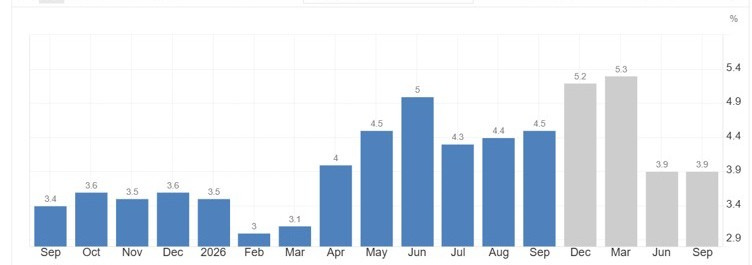
With the latest pressure on oil flow, the dollar has strengthened and the rand lost some ground. This will contribute to inflation, but the forecast of inflation in South Africa still sees controlled levels after a transitory spike.
South Africa Inflation Rate
Snippets from the market
Pakistan, Saudi Arabia and Turkey have agreed to a joint military deployment. Focused in Saudi Arabia, the force will be targeting Houthi rebels. A power station was recently attacked that supplies electricity to the Prophet’s Mosque in Medina, one of Islam’s holiest sites.
A new Reuters/Ipsos poll has President Donald Trump’s approval rating at an all-time low, with Hispanic voters now vocally opposing Republican overtures.
Paramount Skydance has finally completed its $110-billion takeover of Warner Brothers, forming Skydance, one of the world’s largest entertainment powerhouses. From Harry Potter to Batman, it’s all under one roof now.
Kenya has confirmed its first Ebola case after a Kenyan travelling from the Democratic Republic of Congo died in Nairobi. Eight family members and 21 healthcare workers have all been quarantined as a result.
British diplomats will maintain a scaled-down mission in East Jerusalem after Israel ordered the consulate closed. The diplomatic rift follows new UK sanctions, though Britain’s embassy in Tel Aviv is unaffected.
Former UN High Commissioner for Human Rights Navi Pillay was awarded the 2026 Nobel Peace Prize on Friday, 9 October 2026. She won it for her work promoting peace and international law, from opposing apartheid to serving on international courts.
Trade, Industry and Competition Minister Parks Tau has suffered a major blow after the High Court in Pretoria reviewed and set aside the promulgation of the broad-based BEE (BBBEE) legal sector code aimed at transforming the sector. This means the first transformation framework specifically for the legal sector is now legally invalid and will no longer be operational. Law firms will no longer be rated according to the legal sector code, which they argued set “impossible targets”.
Defence Minister Angie Motshekga said that the poor state of the South African National Defence Force’s vehicle fleet was adding to the pressure of executing its duties as part of Operation Prosper.
A new report by the Centre for Development and Enterprise (CDE) warns that Johannesburg’s failing services are being exploited by corrupt officials, contractors and criminal networks. It says infrastructure theft creates repair contracts, water shortages generate lucrative tanker business, and breakdowns enable emergency procurement. The city spends about R20 billion a year on goods and services, making procurement a major target for corruption.
KwaZulu-Natal municipalities owe the province’s largest bulk water supplier more than R5.2 billion, raising concerns that mounting debt could undermine the water infrastructure needed to keep the province supplied in the years ahead.
Sport, Arts and Culture Minister Gayton McKenzie’s latest controversy centres on allegations that he appointed and benefitted from close associates and Patriotic Alliance members in Ticketpro’s new corporate structure, the Ticketpro Group, including McKenzie’s former chief of staff Bakang Lethoko who was named CEO of Ticketpro. Additionally, two other people linked to the PA serve as directors in the Ticketpro Group.
The National Consumer Commission has launched the National Opt-Out Registry under amendments to the Consumer Protection Act to enable South Africans to block unwanted marketing calls, SMSs and other electronic communications.
Financial services group Sanlam plans to take full ownership of South Africa’s largest short-term insurer, Santam, in a deal that would see it delist from the JSE after 62 years. Sanlam, which already owns 62.7% of Santam, has offered R505 a share for the remaining 37.3%, valuing the transaction at about R16 billion.
Using artificial intelligence, researchers may have found a way to make mRNA vaccines, such as Moderna’s and Pfizer’s Covid-19 shots, stable at room temperature. This could reduce costs and make the vaccines more accessible in regions where ultra-cold storage is unavailable.
Pope Leo has been diagnosed with lung cancer but is recovering well after an operation.
A US biotech company says it is making progress toward resurrecting the extinct dodo by using a newly developed AI platform. Dallas-based Colossal Biosciences is attempting to perform gene-editing on the bird’s closest living relative, the Nicobar pigeon, to give it the flightless bird’s signature traits.
China and North Korea officially opened the New Yalu River Bridge, a 3km land border crossing completed in 2014 that had sat unused for a decade. The opening signals a push to rejuvenate cross-border trade and commerce between Beijing and Pyongyang, helping facilitate the movement of raw materials and heavy equipment despite ongoing UN sanctions.
Suspended deputy national police commissioner Lt-Gen Shadrack Sibiya has resigned from the South African Police Service (SAPS).
Transport Minister Barbara Creecy has ruled out additional government funding for the cash-strapped Road Accident Fund (RAF), saying its financial and management problems must be addressed.
At least 43 people were killed in 45 suspected political attacks in the first nine months of this year. The tally topped the full-year total of 30 for 2021, the year of the previous municipal elections, and 33 in 2024, when the last national election was held.
The International Monetary Fund (IMF) has kept its 2026 growth forecast for South Africa largely steady at 1% compared with the 1.1% predicted in July.
Manufacturing production slumped 4.3% year on year in August, dragged down by several divisions, including petroleum, motor vehicles, wood, food and beverages, as well as basic iron and steel. The sector has been on a weakening trend since April.
British American Tobacco South Africa (BATSA) has urged government to strengthen enforcement against illegal producers and distributors, while reviewing tobacco excise duties to improve the competitiveness of legal products.
President Emmanuel Macron has condemned what he called “shocking” scenes of violence from riots about the ongoing cost of living spreading through France. Macron added that he would be bringing together affected groups to figure out a solution.
Confirmed Ebola cases in the Democratic Republic of Congo have climbed past 10,000, with fatalities reaching nearly 4,900 in the country’s deadliest outbreak on record. Regional health authorities voiced mounting concern over cross-border transmission after infections spread to Kenya and Nigeria.
Kenya confirmed an eighth Ebola case as a regional outbreak continued to spread.
Nigeria has confirmed it has a case of Ebola in Abuja.
Suliman Carrim, a Northwest businessman and former ANC regional treasurer, was arrested at OR Tambo International Airport on 15 October 2026 before boarding an international flight. Authorities say the arrest was linked to his alleged failure to appear before the Madlanga Commission of Inquiry after being subpoenaed.
Residents in Alberta voted to remain part of Canada, rejecting separation in the province’s first-ever independence referendum. The result provides a significant boost for Prime Minister Mark Carney as his government works to unify the country amid an ongoing trade conflict with the US.
A long-thought-extinct slow loris has been discovered alive and, relatively speaking, well. The Bangka slow loris, a venomous tree-dwelling slow-arse has been rediscovered in Indonesia. Tin mining, deforestation and general human degenerate activity contributed to the creature’s critically depleted habitat. Its venom can cause severe anaphylactic reactions in humans which might be fatal.
Microsoft has developed an AI tool that can diagnose patients step by step as doctors do, and claims that it is twice as accurate as general physicians at solving complex medical cases.
Nepal will receive $20 million in aid from the UN’s climate loss and damage fund, following the catastrophic floods in August. That’s nice and all, but the floods caused an estimated $2.7 billion in damage to infrastructure and killed about 1,500 people. More than 5,000 are still missing.
Two critical vulnerabilities have been identified in PHP, a widely used programming language that powers websites and web applications. These vulnerabilities could allow malicious cyber actors to remotely execute code in PHP core, potentially compromising sensitive data and networks. For this reason, many websites closed to protect data, including South Africa’s Presidency and Glacier.
Sports Minister Gayton McKenzie made repeated visits to JSE-listed technology group Blu Label before it sold its Ticketpro subsidiary to a consortium linked to his political party, fuelling suspicions about his influence on the controversial deal.
President Luiz Inácio Lula da Silva has won a fourth term in office, beating Flávio Bolsonaro by the skin of his teeth. His re-election effectively halts the far right in Brazil at its apogee. Senator Flávio Bolsonaro has fled to the US after defying an order to hand over passports and, presumably, face Brazilian justice. Bolsonaro faced a money laundering probe in which he has denied guilt. Although nothing quite says “innocent” like fleeing the country instead...
France’s Marine Le Pen officially launched her presidential campaign on Sunday. Le Pen capitalised on the riots and looting, vowing to make it a priority to resolve the recent period of upheaval in France should she win.
Police at OR Tambo International Airport seized a R200m cocaine shipment hidden inside luggage arriving from Brazil. Meanwhile, Brazilian detectives are cracking down on an organised crime ring that uses commercial flights to traffic drugs into South Africa and around the world.
Egypt has greenlit military support for Saudi Arabia in its ongoing defence against the Houthis. The Egyptian parliament authorised President Abdel Fattah al-Sisi to take “all necessary measures” to assist the Saudis.
The man who took the fall for apartheid-era atrocities, former Vlakplaas commander Eugene de Kock, has told the Khampepe Commission of Inquiry into delayed post-TRC prosecutions that while he served 20 years in C-Max, no one in the prosecutorial authority approached him to provide the names, times and dates of those further up the chain of command who gave the orders.
Two high-speed trains have collided in Spain, prompting the rail operator to suspend critical routes as emergency teams respond to the incident. More than 68 people were killed and many more injured. This is the second Spanish train disaster this year.


Comments